
Why are you still standing on the pier watching everyone else enjoy the harbour? Securing marine finance shouldn't feel like you're drowning in paperwork or dodging hidden fees while the best boats get snapped up by someone else. It's a common frustration to find the perfect vessel only to be slowed down by confusing jargon about secured versus unsecured loans. You want to be on the water, not stuck at a desk waiting for an approval that might never come while the best weather passes you by.
We agree that the process needs to be faster and much more transparent. This guide is your direct roadmap to securing a competitive rate that respects your family budget and gets you moving. We'll break down the 2026 market landscape, explain the latest AMSA safety regulations, and show you exactly how to simplify the application process. You'll gain a clear understanding of the total cost of ownership so you can hit the ramp with total confidence. Let's get your boat or jet ski sorted without the stress.
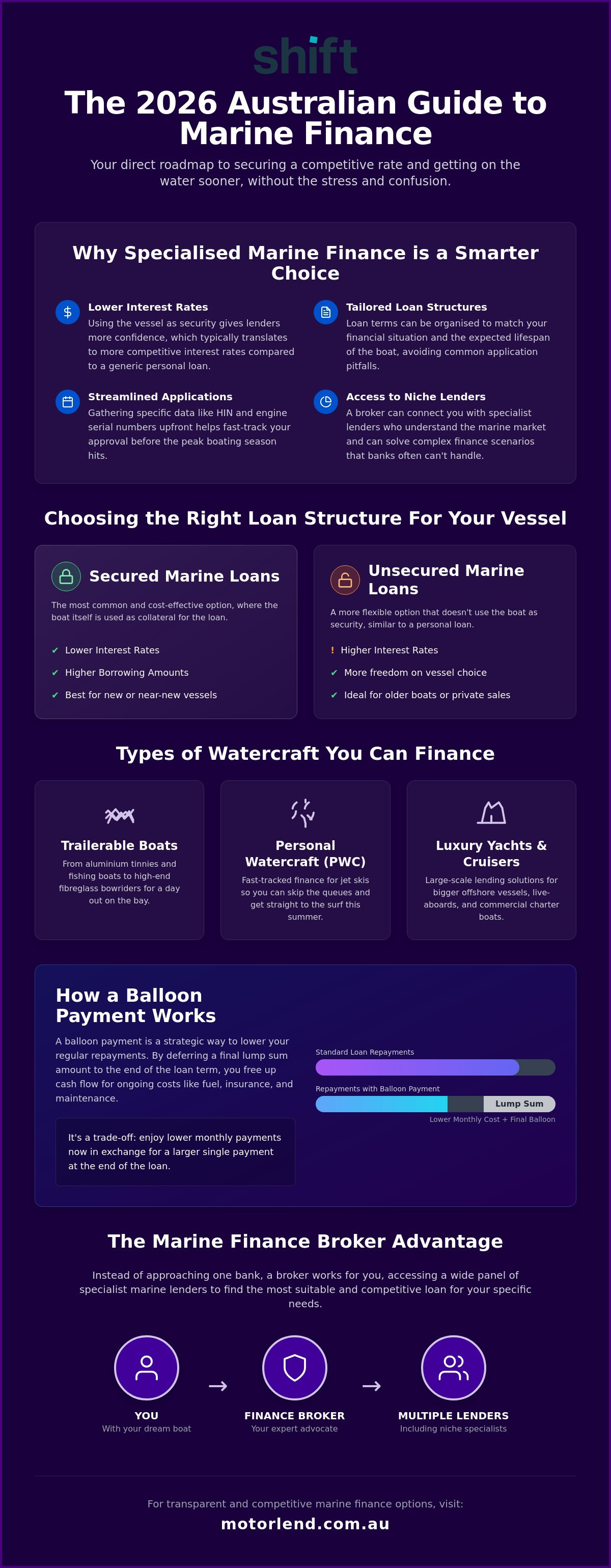
• Understand why specialised marine finance is a better fit than a basic personal loan for securing lower interest rates on your new vessel.
• Identify whether a secured or unsecured loan structure suits your boat's age and your financial situation to avoid common application pitfalls.
• Streamline your path to the water by gathering specific data like HIN and engine serial numbers before the peak boating season hits.
• Learn how a broker accesses niche lenders to solve complex finance scenarios that traditional banks often struggle to handle.
Marine finance is a tailored credit facility for aquatic assets that accounts for unique depreciation rates. Unlike a standard personal loan you might use for a holiday or home renos, marine finance is built specifically for the water. In the Australian market, the vessel itself usually serves as the primary security for the debt. This structure is often formalised through a Chattel Mortgage for commercial operators or a secured consumer loan for private weekenders. It's a setup that gives lenders more confidence, which usually translates to better terms for you.
By 2026, lenders have become much more specific about what they'll fund. They don't just look at your bank balance; they scrutinise the vessel's age, engine type, and intended use. Whether you are eyeing off a brand-new centre console or a tidy used cruiser, the boat's specifications directly influence your approval chances and interest rate. It's about matching the right money to the right hull.
You aren't limited to just one type of boat. Most marine finance packages cover a wide range of assets, including:
Everything from entry-level aluminium tinnies for the creek to high-end fibreglass bowriders for the bay.
Fast-tracked jet ski finance for those who want to skip the queues and get straight to the surf.
Large-scale lending solutions for offshore vessels and permanent live-aboards.
Getting the right hull is only half the battle. You also need to organise a loan structure that won't leave you high and dry. In the Australian market, marine finance usually splits into secured and unsecured paths. Lenders view boats differently than cars because marine assets face unique depreciation curves. A high-end outboard motor might lose value faster than the hull it's bolted to; this reality directly influences how a bank structures your debt. It's a specialist area that requires a bit more thought than a standard car loan.
Secured loans are the go-to for new or near-new vessels. Because the lender holds a mortgage over the boat, they can offer much lower interest rates. If you are looking at a pre-owned vessel, always check the Personal Property Securities Register (PPSR) to ensure the seller has clear title. Unsecured loans provide more freedom for older boats or private sales where a Hull Identification Number (HIN) is tricky to verify. You'll pay a higher rate for the privilege, but you won't have the bank looking over your shoulder regarding the boat's condition or age.
A balloon payment is a popular way to keep your monthly outgoings low. By deferring a portion of the principal to the end of the term, you free up cash for fuel and maintenance. It's a strategic trade-off. You enjoy lower repayments now in exchange for a lump sum later. To see how this compares to other assets, you can read our guide on car finance australia for a deeper dive into balloon structures. Commercial operators can also look into specific commercial marine finance options, which often provide tax benefits for charter or fishing businesses. If you are ready to see what's possible for your budget, you can start your application online to get a clear picture of your borrowing power.
Getting approved for marine finance is a bit like passing a survey; you need the right gear in the right places. Standard docs like your 100 points of ID, recent payslips, and proof of residency are the baseline. But because you are buying a vessel, lenders need specific technical data. A HIN check is the marine equivalent of a PPSR check for a car. Without that Hull Identification Number and your engine serial numbers, the process stalls. If you are looking at a vessel over 10 years old or a larger off-shore cruiser, don't be surprised if the bank asks for a professional marine survey. This verifies the boat's condition and ensures the value matches the loan amount.
Private sellers often offer better prices, but they come with extra homework. You must verify that the seller actually has clear title. Check that there are no existing encumbrances on the PPSR before you hand over a cent. Ensure the 'rego' is current and ready to be transferred into your name upon settlement. For more tips on handling non-dealer transactions, read our guide to private sale caravan finance as the principles are very similar.
You can't take delivery of your boat until the paperwork is watertight. Lenders won't settle a secured loan until they have a certificate of currency for comprehensive marine insurance in their hands. This policy must list the financier as an interested party to protect their security. It is a non-negotiable step that often catches buyers out at the last minute. Get an insurance quote early to avoid delays on the day you plan to pick up the boat. If you have your documents ready, you can submit your details now to get the ball rolling.
Walking into your local bank for marine finance often feels like trying to fit a square peg in a round hole. Banks love "cookie-cutter" loans, but boats are anything but standard. A broker does the heavy lifting for you. They negotiate rates and terms across a panel of lenders, including niche specialists that don't even talk to the general public. Whether you are financing a boat for a new charter business or have a unique credit history, a broker knows which lender will say yes. At Motorlend, we take a no-nonsense approach to vehicle finance and leisure assets to get you on the water faster.
Big banks often have rigid rules that don't account for the diversity of the Australian marine market. They might shy away from certain hull materials like plate alloy or specific high-performance outboard brands. A broker finds the lender comfortable with your specific setup. This variety usually leads to a much better deal than the single offer you might get at a dealership. It's about having options that actually match your vessel's specs rather than settling for a generic personal loan that doesn't account for marine depreciation.
Your time is better spent checking the swell than chasing bank managers. Our digital application processes mean you can secure a pre-approval while you are still walking around the boat show. Your broker serves as your single point of contact from the first quote through to the final settlement. They handle the bureaucracy and the phone calls while you focus on the fun stuff. If you're ready to stop dreaming and start cruising, you can apply for finance online in just a few minutes. We'll handle the paperwork so you can focus on the horizon.
You've done the hard work of finding the perfect vessel. Now it's time to organise the funding that gets you off the pier and into the blue. By choosing the right loan structure and having your HIN and paperwork ready, you've already cleared the biggest hurdles to ownership. Specialist marine finance is about more than just an interest rate; it's about finding a lender that actually understands the unique value of your hull, trailer, and outboard motor.
Don't let confusing bank jargon or slow approval times keep you grounded while the weather is perfect. Motorlend provides a direct path to the water with access to over 30 leading Australian lenders. We are specialists in leisure and marine assets, offering a fast, no-nonsense approval process that cuts through the typical industry red tape. We take the stress out of the application so you can focus on your first weekend out. Apply for Marine Finance with Motorlend Today and let our team handle the legwork while you prepare the bait. We'll see you out there.
Yes, you can absolutely finance a used boat from a private seller. Lenders will typically require a few extra steps to protect your investment, such as a HIN verification and a PPSR search to ensure the vessel is free of debt. While dealers handle this for you, a broker can help you manage the paperwork for a private sale to ensure the funds reach the seller securely.
As of July 2026, the lowest interest rates for boat loans in Australia start from 5.49% p.a., with a comparison rate of 5.90% p.a. for borrowers with excellent credit. Rates can range higher depending on your credit history and whether you choose a secured or unsecured loan. Some lenders also offer fee waivers during peak boating seasons to attract new borrowers.
You don't always need a deposit to get on the water. Many marine finance specialists offer 100% financing for both new and used vessels if you meet their lending criteria. However, putting down a deposit can be a smart move to lower your monthly repayments and reduce the total interest you'll pay over the life of the loan.
The approval process is now faster than ever thanks to digital application systems. You can often secure a pre-approval within minutes or hours of submitting your initial details online. Once you've found your boat and provided the specific engine and hull details, final settlement and the transfer of funds usually take between 24 and 48 hours.


