
Is it actually cheaper to finance a hybrid than a traditional petrol car in 2026, or are you just paying for a fancy green badge? While the upfront cost of eco-friendly tech is often higher, the right hybrid car loan can flip the script by unlocking lower interest rates that regular vehicles simply cannot access. We know the feeling; you want to slash your fuel bills and emissions, but the confusing mess of HEV versus PHEV jargon and shifting government incentives makes the whole process feel like hard work.
It's true that the rules have changed, especially with the 2025 FBT exemption cut-off for plug-in hybrids, but there are still massive wins to be had if you know where to look. You'll discover how to navigate the $91,387 Luxury Car Tax threshold and secure "green" finance that keeps your monthly repayments low. This guide cuts through the red tape to show you how to organise a stress-free approval, so you can focus on the drive instead of the paperwork.
• Discover how a hybrid car loan unlocks lower "green" interest rates that standard vehicle finance just can't match.
• Learn how to factor long-term fuel savings into your monthly budget to effectively offset the higher upfront purchase price of a hybrid.
• Navigate the 2026 eligibility criteria, including CO2 emission thresholds and the specific tax incentives available for business-use vehicles.
• Understand why comparing dozens of lenders through a broker provides a massive advantage over a single bank's limited product range.
• Master the pre-approval process to ensure you're in the driver's seat when negotiating your best price at the dealership.
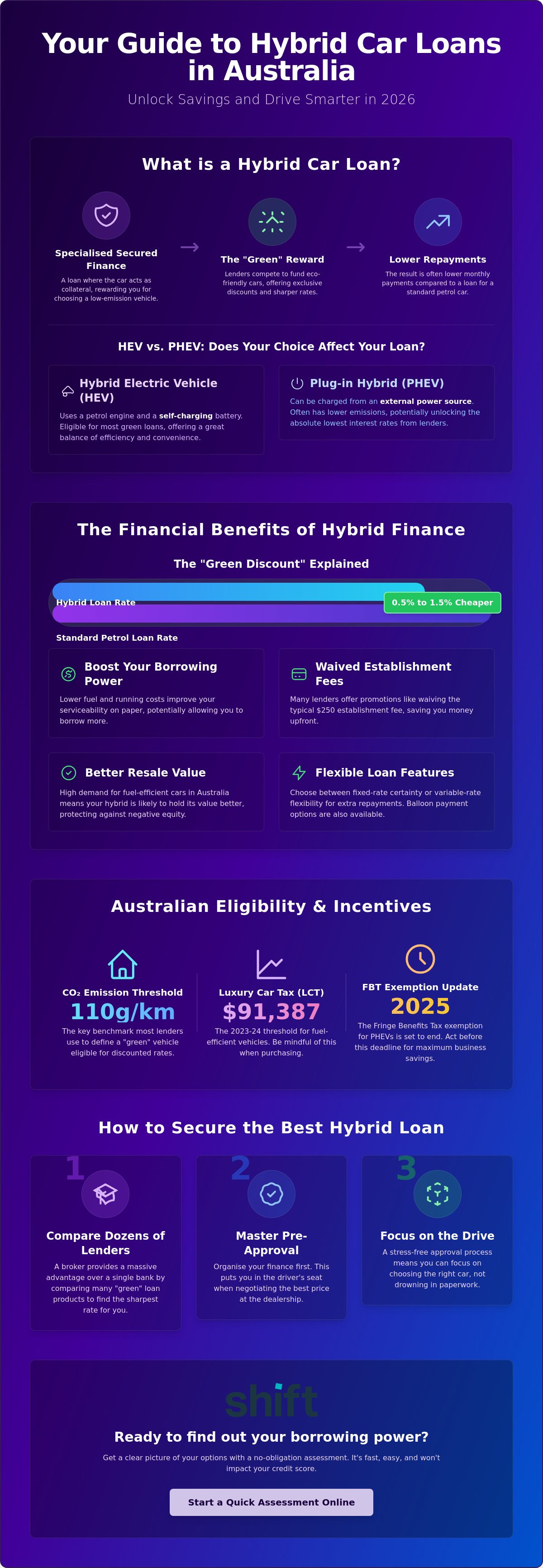
Think of a hybrid car loan as a VIP pass to lower interest rates. It is a specialised form of vehicle finance where lenders reward you for picking a car with lower CO2 emissions. In 2026, Australian banks and private lenders are competing harder than ever to grow their "green" portfolios. This competition works in your favour. It often results in lower monthly repayments compared to what you would pay for a traditional petrol or diesel car loan.
Most buyers choose secured finance. The car itself acts as collateral, which gives the lender more confidence and gets you a sharper rate. Beyond the interest savings, hybrids often boast better residual value. Because demand for fuel-efficient cars is skyrocketing across Australia, your vehicle is likely to hold its price better over the loan term. This helps protect you from "negative equity," where you owe more than the car is worth when it's time to sell or trade up.
Your choice of tech definitely matters. A standard Hybrid electric vehicle (HEV) uses a combination of a petrol engine and a self-charging battery. On the other hand, a Plug-in Hybrid (PHEV) can be charged from an external power source and offers a longer electric-only range. While both are eligible for finance, some lenders reserve their absolute lowest "Green" rates for vehicles with CO2 emissions below specific benchmarks, like 110g/km. PHEVs often find it easier to hit these strict targets because of their larger battery capacity.
Typically, a hybrid car loan offers an interest rate discount of around 0.5% to 1.5% compared to standard petrol models. 2026 has become the turning point for hybrid finance in Australia because the sheer volume of available models has pushed these once-niche loans into the mainstream. Lenders have simplified the approval process, making it just as fast to get a green loan as it is to get a standard one.
Securing a hybrid car loan in 2026 isn't just about feeling good; it's a savvy financial move. Many Australian lenders now offer "green" tiers that shave significant percentage points off their standard rates. For example, major banks have introduced offers where the $250 establishment fee is completely waived if you fund your loan before June 30, 2026. This immediate saving, combined with a lower interest rate, means more of your money goes toward paying off the car rather than lining the bank's pockets.
Lenders love hybrids because they are cheaper to run. When you apply for finance, banks assess your "serviceability," which is your ability to handle repayments. Because you're spending less at the bowser, your disposable income looks healthier on paper. This can actually boost your borrowing power. This Electric Vehicle Council guide highlights how these operational savings contribute to the overall affordability of low-emission vehicles. If you want to see what your specific borrowing power looks like, you can start a quick assessment online.
Choosing between a fixed or variable rate depends on your priority. A fixed rate offers total peace of mind; your repayments won't budge even if the market shifts. However, variable rates often come with more flexibility. They typically allow you to make unlimited extra repayments without a "break fee" penalty. If you plan on using your fuel savings to smash your debt faster, a variable rate might be your best bet. Some lenders even offer variable "green" rates as low as 5.29% p.a. in the current market.
Some lenders were historically cautious about balloon payments on hybrids due to evolving battery tech, but many now embrace flexible residuals as the market matures. A balloon payment lowers your monthly commitment by deferring a chunk of the principal to the end of the term. It's a popular choice for keeping cash flow tight, though it isn't for everyone. You can find more detail on how this works in our Balloon Payments Explained guide.
Getting the green light for a hybrid car loan depends on meeting specific Australian benchmarks. Most lenders use a CO2 emission threshold of 110g/km to determine if a vehicle is "green" enough for a discounted rate. If your chosen model is "A-rated" on the Green Vehicle Guide, you are already halfway to a better deal. While the federal FBT exemption for new PHEV leases ended in April 2025, hybrids still benefit from a higher Luxury Car Tax (LCT) threshold of $91,387 for the 2025/2026 financial year. This allows you to buy a more premium eco-friendly ride without the heavy tax hit that standard petrol cars face.
You aren't restricted to brand-new cars either. Many lenders now offer green finance for second-hand hybrids, provided the vehicle is relatively young and meets the same emission standards. It's a brilliant way to skip the initial depreciation hit while still enjoying "green" interest rates. Just ensure you have the vehicle’s energy rating certificate ready during the application process to avoid any delays.
Business owners can unlock even more value. By using commercial finance, ABN holders may be able to leverage specific tax deductions for fuel-efficient vehicles. Even without the old FBT exemption for new PHEVs, the combination of lower running costs and asset depreciation makes hybrids a smart fleet choice. If you're running a business, check your commercial eligibility today to see how much you could save.
For a personal loan, your credit score remains the biggest factor in securing the sharpest rates. Lenders typically look for a "good" to "excellent" rating to qualify you for their top-tier green products. You'll need standard documentation like recent payslips and bank statements. Some banks also require proof of the car's CO2 emissions to verify it meets their internal green criteria before they sign off on the discount.
Walking into your local bank branch might seem like the easiest path, but it often limits you to a single set of lending criteria. If you don't fit that specific bank's "green" box, you might be stuck with a standard interest rate or a flat rejection. Using a broker gives you a massive advantage by comparing over 30 different lenders at once. This ensures we find the hybrid car loan that actually suits your credit profile and the specific vehicle you've got your eye on. We do the heavy lifting by shopping the market, so you don't have to waste your Saturday morning on hold with multiple banks.
Sorted finance is your secret weapon when you finally hit the dealership. Getting pre-approved means you know your exact budget before you even take a test drive. It effectively turns you into a "cash buyer" in the eyes of the salesperson. When you aren't relying on high-pressure dealer finance to make the deal happen, you have significantly more leverage to negotiate a better drive-away price. You can focus on the car's features while knowing your repayments are already locked in at a competitive rate.
The final steps of the process are faster than most people expect. Once you've chosen your vehicle, the paperwork is handled through a secure digital process. You'll sign your contract online; the lender pays the dealership directly; and you coordinate the pickup. It is a streamlined, modern approach designed to get you behind the wheel without the old-school bureaucratic headache.
We take a no-nonsense approach to finding your green finance. Instead of making you jump through hoops, we quickly identify which lenders are offering the best green-tier rates for your specific hybrid model. Our team handles the back-and-forth with the banks, which leaves you free to focus on the drive. Ready to go green? Apply for your hybrid car loan today.
Start by checking your credit score and gathering your two most recent payslips to speed up the process. It's also a smart move to research your vehicle finance options early to see how different loan terms impact your weekly budget. Once you have your documents ready, the path to a cleaner, cheaper commute is wide open.
Choosing a hybrid isn't just a win for the environment; it's a strategic move for your wallet. You've seen how the right hybrid car loan can unlock lower interest rates and help you navigate the 2026 tax landscape with confidence. By factoring in fuel savings and higher residual values, you're looking at a vehicle that's as efficient to own as it is to drive. The key is moving beyond a single bank's limited offer and comparing the whole market to find a deal that actually fits your lifestyle.
At Motorlend, we are specialists in green-tier vehicle finance. We provide access to over 30 Australian lenders to ensure you get the most competitive rate available. Our process is fast, completely digital, and designed to be stress-free from start to finish. We handle the paperwork and the bureaucracy, so you can focus on picking the right car. Get a quick quote on your hybrid car loan with Motorlend today. Let's get you behind the wheel of your next eco-friendly ride without the hassle.
Yes, a hybrid car loan is typically cheaper because most Australian lenders offer "green" interest rate discounts to reward low-emission choices. These preferential rates can be significantly lower than standard car finance, often by 0.5% to 1.5%. Because your weekly fuel bills are lower, banks also see you as a lower risk, which can help you qualify for better terms and even waived establishment fees.
Most lenders require your vehicle to meet a specific CO2 emission benchmark, which is usually 110g/km or less. While almost all Plug-in Hybrids (PHEVs) hit this target, many standard hybrids also qualify if they have a high energy rating. It's a good idea to check the Green Vehicle Guide before you buy to ensure your chosen model sits in the "A-rated" category for the best possible rate.
You can definitely secure a hybrid car loan for a second-hand vehicle as long as it meets the lender's age and emission standards. Financing a used hybrid is a smart way to skip the initial depreciation hit while still locking in a discounted "green" interest rate. We have access to lenders who specialise in used eco-friendly finance, making it just as easy as buying a brand-new car.
The rules changed on April 1, 2025, meaning new Plug-in Hybrid (PHEV) leases are no longer eligible for the Fringe Benefits Tax (FBT) exemption. However, hybrids still enjoy a higher Luxury Car Tax (LCT) threshold of $91,387 for the 2025/2026 financial year. This allows you to choose a more premium, fuel-efficient model without the heavy tax penalties that apply to standard petrol or diesel vehicles.
The maximum amount you can borrow depends on your credit profile and the value of the vehicle, with the LCT threshold of $91,387 serving as a common benchmark for premium models. Because hybrids have lower ongoing running costs, your "serviceability" or ability to repay the loan often looks better to lenders. This can sometimes result in a higher borrowing capacity than you would get for a traditional petrol car.


