
What if your next major asset purchase didn't touch your working capital at all? It sounds like a dream, but for many savvy ABN holders, it's simply the reality of smart scaling. You've likely felt the frustration of needing new gear to grow while worrying that the upfront cost will leave your bank account bone dry. The traditional path to equipment finance australia is often littered with complex jargon and slow approval times that feel designed to stall your momentum. We agree that you shouldn't have to choose between modernising your fleet and keeping your cash flow healthy.
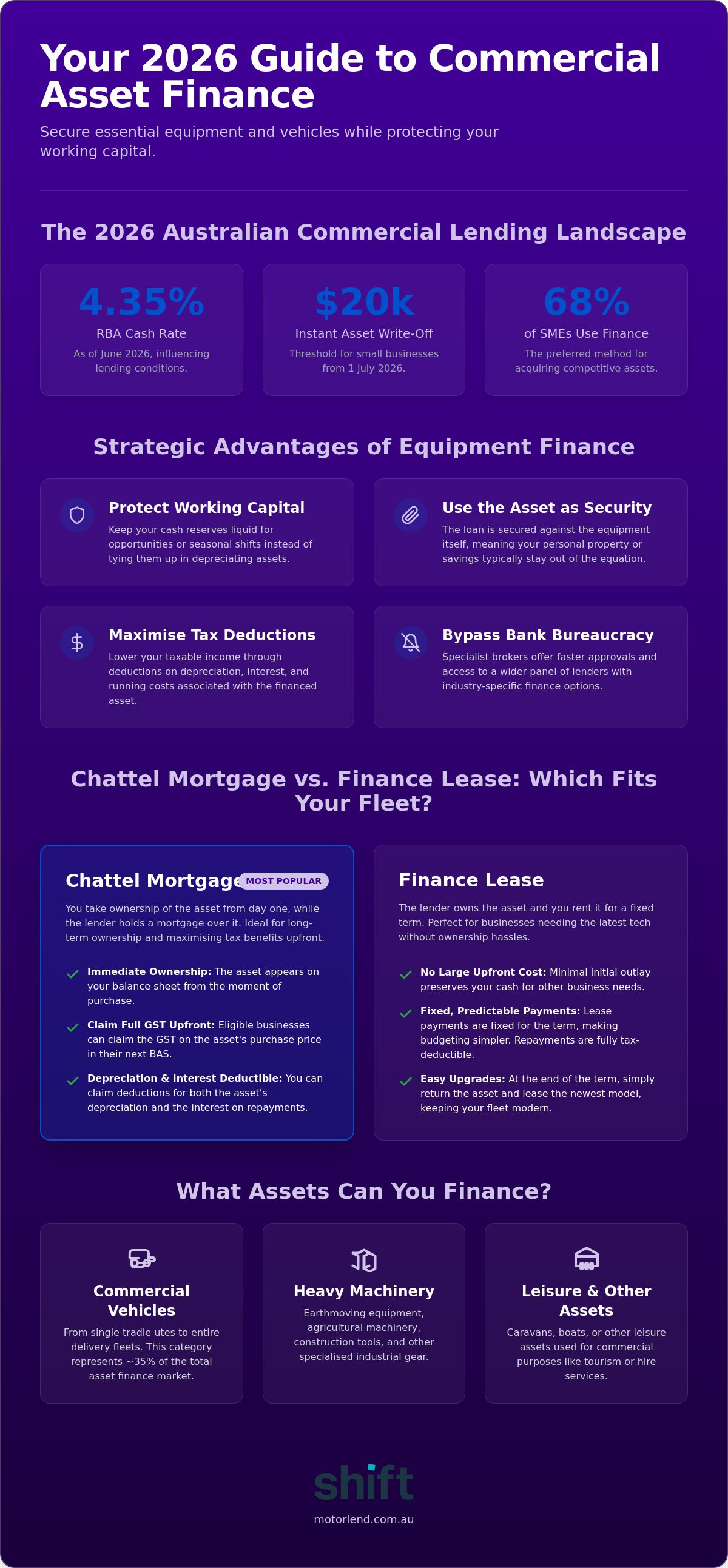
This guide is your roadmap to mastering commercial lending in 2026. You'll discover how to secure essential machinery and vehicles while protecting your reserves. We'll break down the latest 2026 landscape, including the current 4.35% RBA cash rate and the announced $20,000 instant asset write-off threshold for small businesses. We're going to show you how to skip the bank queues, access tax-deductible repayments, and get your new gear working for you without the stress of hidden fees or bureaucratic delays.
• Learn how to secure essential gear without draining your cash reserves, keeping your working capital ready for seasonal shifts or unexpected opportunities.
• Compare the benefits of chattel mortgages and finance leases to see whether immediate ownership or flexible upgrades work better for your fleet.
• Master the tax advantages of equipment finance australia, including how to maximise depreciation and interest deductions to lower your taxable income.
• Find out why bypassing traditional bank bureaucracy through a specialist broker gives you access to a wider range of competitive, industry-specific lending options.
• Discover the strategic way to manage your debt-to-equity ratio by using the asset itself as security for your growth.
Commercial asset finance is a tool for acquiring revenue-generating gear without an upfront balance sheet hit. It is a funding solution where the asset itself acts as security for the loan. This means your property or personal savings usually stay out of the equation. In the current Australian economy, over 68% of SMEs are choosing equipment finance australia to stay competitive without draining their bank accounts.
The 2026 landscape has changed. With the RBA cash rate at 4.35% as of June 2026, smart operators are moving away from rigid bank loans and looking for more flexible equipment finance australia options. They want agile solutions that match the speed of their industry. By using finance, you protect your working capital. This keeps your cash ready for seasonal dips, unexpected repairs, or sudden growth opportunities that require quick liquidity.
You can fund almost any tangible asset that helps your business earn money. The Australian market sees over A$80 billion in new business finance annually, covering a massive range of gear.
This spans from the humble tradie ute to entire delivery fleets. Vehicles represent about 35% of the total asset finance market.
Think earthmoving gear, agricultural equipment, and specialised construction tools.
Caravans or boats used for commercial tourism or hire are also eligible.
Professional audio-visual setups for venues are frequently financed to protect cash flow; you can learn more about JVG Sound Lighting & Visual Pty Ltd and their specialized installation services.
Whether you choose a chattel mortgage or a Finance lease, the focus is on getting the gear on-site and working as fast as possible.
Spending your own capital on a depreciating asset is often a strategic mistake. Once that cash is spent, it's locked away in a machine that loses value every day. Finance allows you to match the asset's cost to the revenue it generates. It turns a huge upfront hurdle into a steady, predictable payment. This approach is particularly effective given the A$20,000 instant asset write-off threshold announced for small businesses starting July 1, 2026. It's about using the lender's money to grow your empire while keeping your own cash under the bonnet for when you really need it.
Choosing the right structure for your equipment finance australia isn't just about finding the lowest interest rate. It's about aligning your debt with your tax strategy and operational needs. Two main paths dominate the Australian market: the Chattel Mortgage and the Finance Lease. While both get you the gear you need, they treat ownership and tax quite differently. Understanding these business financing options helps you keep your balance sheet lean and your growth steady.
The Chattel Mortgage is currently the most popular choice for Aussie businesses, accounting for over 50% of commercial asset loans. You take ownership of the asset from the moment of purchase, and the lender takes a "mortgage" over it as security. A Chattel Mortgage typically allows a business to claim GST on the purchase price in the next BAS. This can provide a significant cash flow injection early in the loan term. If your goal is long-term ownership and maximising depreciation, this is likely your best bet.
Finance Leases work differently. The lender retains ownership, and you pay a monthly fee to use the asset. This is often ideal for businesses that want to upgrade their gear every few years without the hassle of selling old equipment. It keeps your fleet modern and your monthly costs predictable. If you're unsure which path fits your current turnover, you can start a quick application to see tailored structures for your ABN.
A balloon payment is a lump sum paid at the end of your loan term. By pushing a portion of the principal to the final instalment, you significantly lower your monthly commitment. The trick is strategic alignment. You should aim to match the balloon payment to the expected resale value of the asset. This ensures you aren't left with a debt larger than the machine's worth when it's time to trade in.
Financing a 20-tonne excavator is a different beast compared to a fleet of delivery vans. Lenders look closely at the 'useful life' of the asset. Heavy machinery often holds its value longer, which can allow for extended loan terms. However, specialised gear requires a broker who understands the secondary market for construction and agricultural equipment. The durability of the gear dictates the risk, and a specialist knows how to present that to a lender to secure better terms.
Using equipment finance australia isn't just about getting gear; it's a strategic move for your tax bill. By financing, you can often deduct the interest and depreciation of the asset from your taxable income. This lowers your tax liability while you're actually using the machine to make money. It's much smarter than a massive cash outlay that doesn't offer the same ongoing relief. For more on the broader strategy of scaling, check out our Commercial Finance in Australia: The 2026 Guide.
Secured loans also look better on your books. Since the asset itself acts as the security, it doesn't weigh as heavily on your credit capacity as an unsecured business loan might. This protects your debt-to-equity ratio, making you look more attractive to lenders if you need funding for other projects later. You can even tailor your repayments to match your business cycle. If your work is seasonal, like agriculture or tourism, you can often structure payments to be higher when cash is flowing and lower during the quiet months.
The Australian Government has announced a permanent A$20,000 instant asset write-off threshold for small businesses with turnover under A$10 million, starting July 1, 2026. While this measure is still being finalised as law, it provides a massive incentive to upgrade your fleet. Timing your purchase right before the end of the financial year (EOFY) can maximise your deductions immediately. It's about making the tax system work for your growth, not against it.
With the RBA cash rate sitting at 4.35% as of mid-2026, many businesses prefer the certainty of fixed rates. Fixed monthly repayments mean no surprises. You can budget with precision, knowing exactly what is leaving your account every month. In a fluctuating economy, this peace of mind is the gold standard for commercial lending. It allows you to focus on your operations instead of watching the news for rate hikes. Apply now to lock in a fixed rate for your next asset purchase.
Falling into the 'One-Bank' trap is a common mistake for busy business owners. Your local bank manager can only offer you one set of restrictive criteria. If your business doesn't fit their specific box, you'll likely face a rejection or a slow, painful process. A specialist broker changes the game by giving you access to a wide panel of lenders. They find the one that actually understands your industry, whether you're in civil construction or regional transport. You can apply for commercial equipment finance today to see how multiple lenders compete for your business.
Brokers handle the heavy lifting of paperwork while you stay on the tools. This speed and simplicity are essential when you need gear on-site to start a new contract. Instead of waiting weeks for a bank committee, a broker-led application for equipment finance australia can often see you approved and ready to go in just a few days. It's a more direct route to growth that skips the traditional bank bureaucracy.
Getting started is easier than you think. You generally only need your ABN, recent bank statements, and the details of the asset you want to buy. Once you submit these, the process moves quickly. From the initial application to having the keys in your hand, a typical commercial approval can happen in as little as 24 to 48 hours for well-documented businesses. It's about removing the friction so you can focus on scaling your operations without the stress.
It's tempting to only look at the interest rate, but the lowest number isn't always the best deal. Restrictive terms can choke your business later. You need to look at payout flexibility, early termination fees, and whether the lender allows for easy upgrades. A partner who understands the Australian commercial landscape will look at the whole picture. They ensure your equipment finance australia setup supports your long-term goals rather than just ticking a box for today. Having an expert in your corner means you get a structure that actually works for your cash flow; similarly, for those managing physical business locations, AllCover Insurance Brokers offers tailored risk solutions for commercial property owners.
Scaling your business shouldn't feel like a battle against your own bank account. By choosing the right structure for your equipment finance australia, you turn depreciating assets into revenue engines while keeping your cash reserves intact. Whether you're leveraging the latest tax write-off incentives or structuring repayments to match your seasonal income, the goal is simple: get the gear you need without the financial headache.
Don't let slow bank approvals or complex jargon stall your momentum. Working with a specialist who understands heavy machinery and commercial fleets gives you a massive advantage. We provide access to a wide panel of leading Australian lenders; this ensures you get a deal that actually fits your industry. Our process is built for busy business owners who value their time and need fast, stress-free approvals. It's time to skip the red tape and get your next project moving.
Organise your commercial finance with Motorlend today and take the next step toward your business goals. Your growth is our priority; let's get that gear on the road and working for you.
The main difference is when you take ownership of the asset. With a chattel mortgage, you own the gear from day one while the lender takes a mortgage over it as security. In a commercial hire purchase, the lender owns the asset until you make the final payment. Most Aussie businesses now choose a chattel mortgage for equipment finance australia because it usually allows them to claim the GST on the purchase price upfront in their next BAS.
Yes, you can definitely secure funding as a new business. While traditional banks often want two years of trading history, many lenders on our panel offer "low doc" options for ABN holders who have been active for at least six months. You might need to provide a larger deposit or show strong bank statements to prove your cash flow. We specialise in finding flexible paths for new operators who need gear to get their first contracts moving.
Yes, the interest component of your repayments is generally tax-deductible if the asset is used for income-producing purposes. This is one of the primary reasons equipment finance australia is so popular among small and medium enterprises. You can also typically claim depreciation on the asset, which further reduces your taxable profit at the end of the financial year. It's a smart way to lower your tax bill while upgrading your fleet.
You can sell the asset at any time, but you'll need to pay out the remaining loan balance first. This payout includes the outstanding principal and any balloon payment attached to the contract. Once the lender receives the funds, they release their security interest on the Personal Property Securities Register (PPSR). This ensures the new buyer receives a clear title, free of any encumbrances or legal debt.
No, you don't necessarily need a deposit to get started. Many established businesses with a good credit profile can access 100% finance, which covers the full purchase price plus any delivery or fit-out costs. If you are a new start-up or have a complex credit history, a lender might ask for a 10% or 20% deposit. This reduces their risk and can sometimes help you secure a more competitive interest rate.


